Locale: en

Field maintenance, fertilization and harvesting

Our production

We cultivate our grassland and arable land with the utmost care. For several years, we have been working according to the PLOCHER® concept , which strengthens the soil independently of chemical fertilizers and pesticides. Furthermore, we fertilize our fields with liquid manure, which is processed in our biogas plant , where a large portion of the methane is extracted and used for energy production. The conversion into a high-quality compost product begins during storage. As a result, our liquid manure is almost odorless and does not harm the soil or groundwater ; instead, it helps stimulate soil life and provide it with essential nutrients. Before harvesting begins, we use drones to check the fields to ensure that no wild animals are hiding in the tall grass. Together with other farmers, we founded the organization "Aktion Rehkitzrettung Immendingen eV" (Immendingen Fawn Rescue Association) . The grass is harvested at a cutting height of approximately 10-12 cm using high-cut skids and reduced mowing speed. This minimizes the amount of soil and sand kicked up during mowing, ensuring clean cuttings. The harvested material can then lie loosely and airily on the appropriately high turf to dry.

Harvesting and drying the hay

The hay is now partially dried in the field and then raked into mowers. The advantage of these machines is that they don't pick up dirt and carefully gather the harvested material. This not only ensures clean quality but also prevents the loss of crumbling material that occurs with prolonged ground drying, especially with frequent turning and raking. Furthermore, the hay is baled while still damp. This retains lighter stem fragments that would otherwise fly off during drying and prevents the stems from breaking during baling. Thanks to our drying facilities, we can then dry the hay to an optimal residual moisture content of 10%, regardless of the weather, thereby preventing fermentation and the formation of harmful microorganisms.
After drying, the hay is stored in our modern and insulated warehouses, waiting to be ordered by you and fed to your horse!

The grass is dried loosely in the field until it reaches a residual moisture content of no more than 45%, and then raked into small mounds using a gentle belt rake. The advantage of these machines is that they don't pick up any dirt and carefully gather the harvested material. This ensures not only clean quality but also prevents losses due to crumbling.
The harvested crop is now baled and immediately wrapped in film using a bale wrapper. We do not add any silage additives or acids. The bales are then collected, marked, and transported to storage to avoid disrupting the fermentation process. Lactic acid bacteria begin converting the sugars naturally present in the plants into lactic acid, which lowers the pH level. This acidic environment preserves the forage and prevents the growth of harmful microorganisms.
After 6-8 weeks of storage, the ripening process is complete and the bales are ready to be fed to your horse!

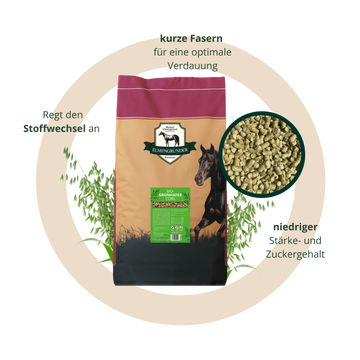
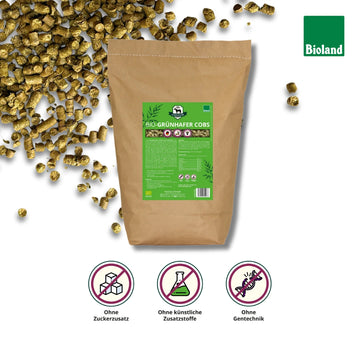
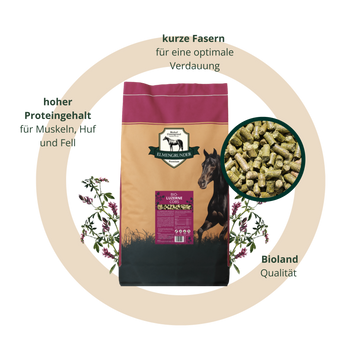
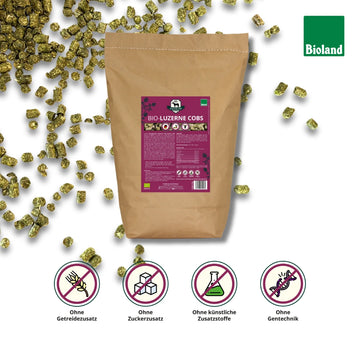
All components of our concentrated and supplementary feeds, such as nettle, alfalfa, sainfoin, green oats, etc., are grown by us on our own organic farm, Elmengrund. The plants are carefully harvested at the perfect time using our harvesting machines and then dried with warm air in our drying facility.
Our high-quality, dust-free products are then processed into cobs or bites. And all this without added sugar, molasses, preservatives, or any other additives.
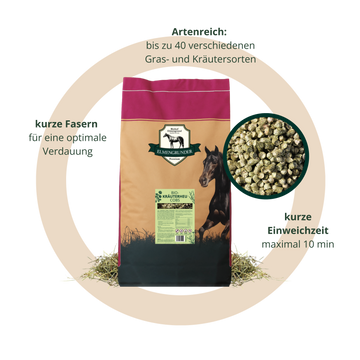
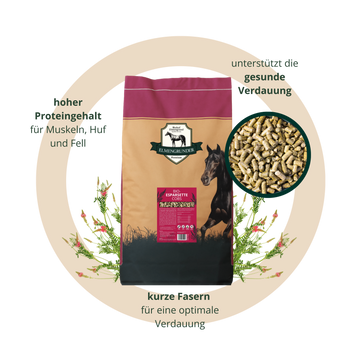
We take care to ensure that the fibers pressed into cobs are as small as possible, only 1-4 mm, to guarantee optimal digestion.
The morsels have a fiber length of at least 5cm so that the horses can still perfectly roll up, chew and utilize the fiber.
Finally, the cobs or bites are then packed with lots of love for your horse.

Products that we manufacture ourselves